
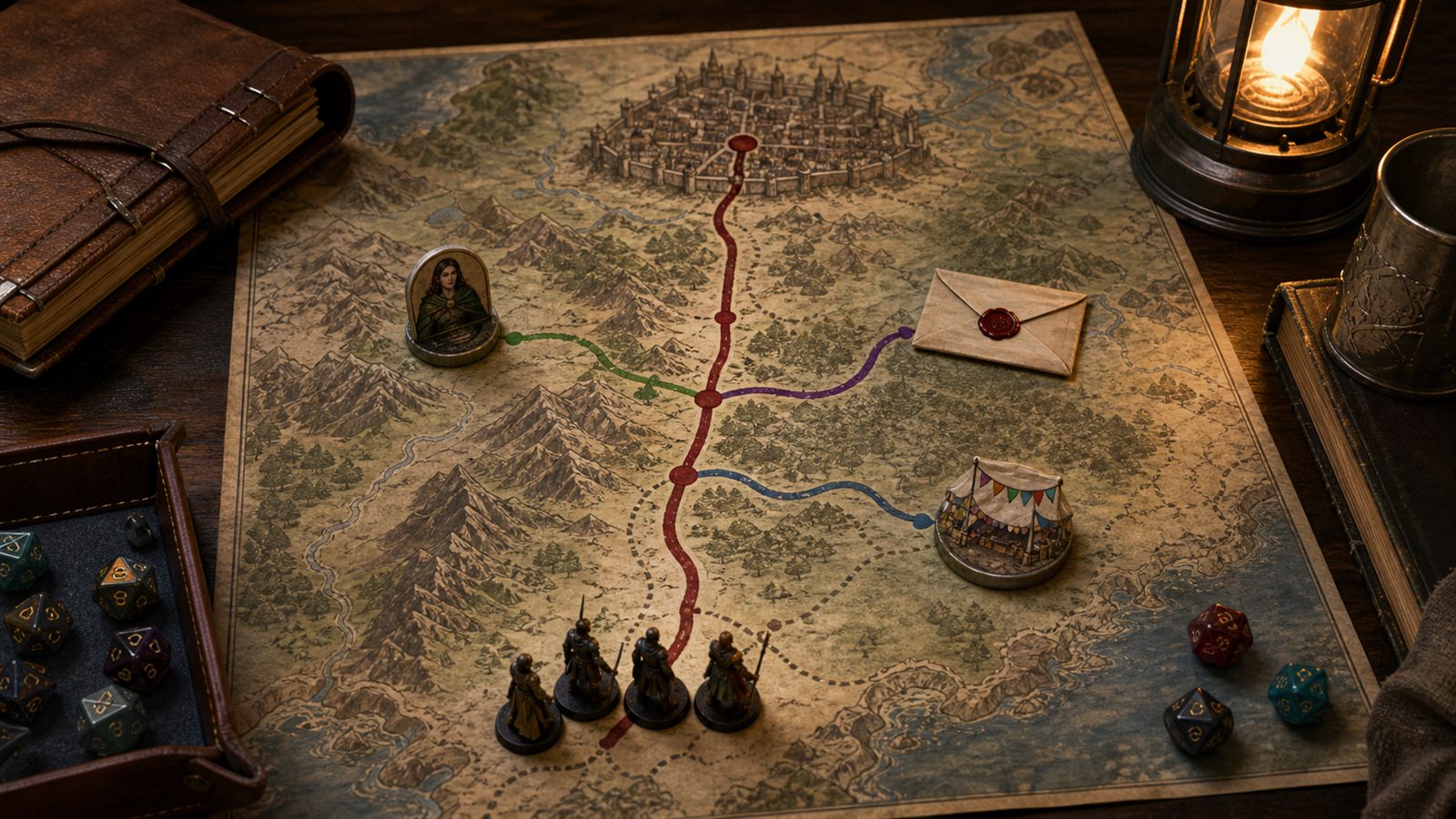
A long D&D campaign needs more than one thing going on. The party may be trying to stop a war while a character’s estranged sibling arrives, a trusted guide hides a debt, and an old ally calls in a favor.
Those threads make the campaign feel inhabited. They also make prep harder when every loose end claims to be urgent.
Do not cut every side story or promote each one into a second campaign. Give a subplot a clear job, connect it to current play, prepare a small amount of movement, and limit how much attention it receives. Then let the players decide which invitations they answer.
Prepare the pressures and possible consequences—not the character decision that resolves them.
First, name the campaign’s main question
You cannot tell whether a side thread supports the campaign until you can say what the campaign is currently about. This is not the setting’s complete history or the villain’s entire plan. It is the question pulling the party forward now.
- Can the party prevent House Veyr from taking the river cities?
- Will they find a cure before the winter sickness reaches home?
- Who is using the old imperial roads to move forbidden weapons?
The question may change when an arc ends—or when the players keep choosing something else. For the next few sessions, make it clear enough to test whether a subplot adds pressure, information, character, or contrast.
Use the Job, Link, Beats, Limit method
Four decisions turn an interesting note into a playable thread without deciding how the characters must respond.
Job
Why does this thread deserve table time?
Relationship, revelation, parallel, or contrast.
Link
Which campaign choice can it change?
Connect it to a cost, relationship, resource, deadline, or fact.
Beats
How does the situation move?
Invitation → Turn → Outcome.
Limit
What protects the campaign’s focus?
Cap prep and decide what moves if ignored.
Job: decide why the thread earns table time
A subplot is not simply a note marked “interesting.” Choose one primary job before preparing it.
Relationship
Show loyalty, resentment, affection, fear, or disagreement that the main adventure does not reveal.
Revelation
Change what the party understands about a person, place, faction, or earlier event in a way that affects a present choice.
Parallel
Put a smaller version of the campaign’s central question in front of another person or group.
Contrast
Approach the campaign’s concerns from another angle, provide relief, or show an alternative moral choice.
A thread may do more than one thing in play. Trying to reveal every secret, deepen every relationship, and fix the pacing at once usually creates another main plot.
Link: connect the thread to a real campaign choice
A useful subplot is separate enough to show another part of the world and connected enough to matter. Write one sentence:
This side thread matters to the campaign because it changes ________.
Fill the blank with a choice, cost, relationship, resource, deadline, or piece of information. “Because it is part of the character’s backstory” is not enough. Backstory earns table time when it changes what happens now.
- The scout’s mentor matters because helping him exposes the party’s route to House Veyr.
- The union strike matters because it forces a choice between a quiet investigation and public support for workers.
- The festival matters because it gives the villain a crowd to hide in and gives the party a public forum.
The connection does not make the subplot mandatory. It ensures that, if players engage, their decision belongs to the campaign rather than a disconnected errand.
Beats: give the thread a small arc
Side threads need movement. If a mentor appears, explains a problem, and is never mentioned again, that is a guest appearance. If the request changes, raises pressure, and reaches an outcome, it becomes a subplot.
1. Invitation
Put the thread in front of the party in a form they can accept, postpone, investigate, or refuse.
2. Turn
Change the first assumption, raise the cost, or introduce someone with a competing want.
3. Outcome
Let the thread resolve, transform, or become a conscious open question because of player choices.
A coded letter from the scout’s mentor is the invitation. Learning that he plans to sell evidence of the scout’s old failure is the turn. Protecting him, exposing him, buying his silence, or walking away creates the outcome.
Three beats are often enough. The thread can earn more time after the players choose to keep pulling on it. Strong NPC motivations help each person create pressure without dictating the party’s answer.
Limit: protect the campaign’s focus
Every side thread needs two limits. They prevent the DM from spending half the campaign on an idea the table did not choose.
Attention limit
Decide how much table time the thread receives before it returns something to the main campaign: perhaps one scene this session or one scene across two sessions.
Momentum limit
Decide what changes if the party leaves it alone. The world may move, but declining your invitation should not become a punishment.
If the party ignores the mentor’s letter, he may sell the evidence in a week. Let them learn through a changed patrol rather than a lecture about what they missed. The 10-minute faction turn offers a lightweight way to advance that off-screen pressure.
A one-card subplot template
Keep each answer brief. The card should tell you what to put in front of the players, not how their characters must resolve it.
Job
What primary job earns this thread table time?
Link
Which current campaign choice can it change?
Invitation
How can the party notice, postpone, or refuse?
Turn
What new fact, cost, or competing want appears?
Outcome
What can change because of the party’s choice?
Attention Limit
How much table time will you prepare?
Momentum Limit
What moves if the party leaves it alone?
Keep the card beside your session notes so each beat starts from what the party actually chose last time.
SIDE THREAD
Name:

JOB
Relationship, revelation, parallel, or contrast:

LINK
This matters to the campaign because it changes:

INVITATION
How can the party notice and choose to engage?

TURN
What new fact, cost, or competing want changes the thread?

OUTCOME
What can change because of the party's choice?

ATTENTION LIMIT
How much table time will I prep before it proves its value?

MOMENTUM LIMIT
What moves if the party leaves it alone?

PREPARE PRESSURES, NOT PLAYER DECISIONS.
Weave subplots into sessions without cutting away from the party
Film can cut to another character without the protagonists present. A tabletop scene that does the same may leave players watching the DM tell a separate story.
Keep the party in the scene whenever possible. Let the subplot arrive through a visitor, message, consequence, location, or problem they can touch. If you show an off-screen event, keep it brief and use it to provide information that supports a decision.
Side threads can also control pacing. A relationship scene after a hard fight offers a different kind of choice. A deadline during a quiet investigation adds pressure. The shift should help the session breathe, not feel like an interruption.
Let player characters opt in
Personal threads are easy to mishandle. You may want to explore a character’s family, past, faith, or flaw while the player wants something else from the next few sessions.
Would you enjoy seeing more pressure around your character’s old mentor, or would you rather keep the next few sessions focused on the city plot?
You do not need to reveal the surprise. Check whether the territory is welcome, then present choices with more than one good answer. The player spotlight tracker can help you record active character priorities without turning them into compulsory scenes.
Example: one campaign, three side threads
Main question: Can the party stop House Veyr from taking the river cities?
| Thread | Job | Link | Three beats | Limit |
|---|---|---|---|---|
| Scout’s mentor | Relationship | Exposes the party’s route to Veyr | Letter → blackmail → evidence choice | One meeting and one consequence |
| Dockworkers’ union | Parallel | Tests the cost of public disruption | Strike rumor → delay → support or restraint | One scene; advances only if revisited |
| Midsummer festival | Contrast | Gives Veyr cover and the party a forum | Invitation → sabotage → crowd or target | One session; close with the result |
Common subplot mistakes
Giving every loose note an arc
Some details are texture, some are hooks, and some are history. Twenty active subplots create obligations, not a living world.
Making the thread unrelated
If it changes no current choice and reveals nothing meaningful, it becomes easy to ignore and hard to remember.
Advancing a personal story without consent
Present people and pressure. Never decide that a player character forgives someone or changes a belief.
Never letting a thread end
When a thread reaches an outcome, record what changed and stop feeding it unless players return.
Letting the B story take over by accident
If players choose a side thread repeatedly, update the main question. Their interest may have changed the campaign.
Keep a record of where each thread began
A side thread is easier to run when you can find its origin: the session where the mentor appeared, the agreement that earned the union’s trust, or the choice that put the festival at risk. The campaign continuity audit can help organize that history manually.
DMForge can preserve original session notes and keep reviewed encounters, people, places, factions, and relationships connected to the campaign record. That makes the source of an old promise or recurring relationship easier to revisit.
Start a free campaignGive the party more to care about—not everything at once
A subplot earns its place by changing the campaign or revealing something meaningful about it. Give the thread a purpose, connect it to play, let it move, and know when to stop. If players keep choosing it, follow their interest. It may no longer be the side story.