
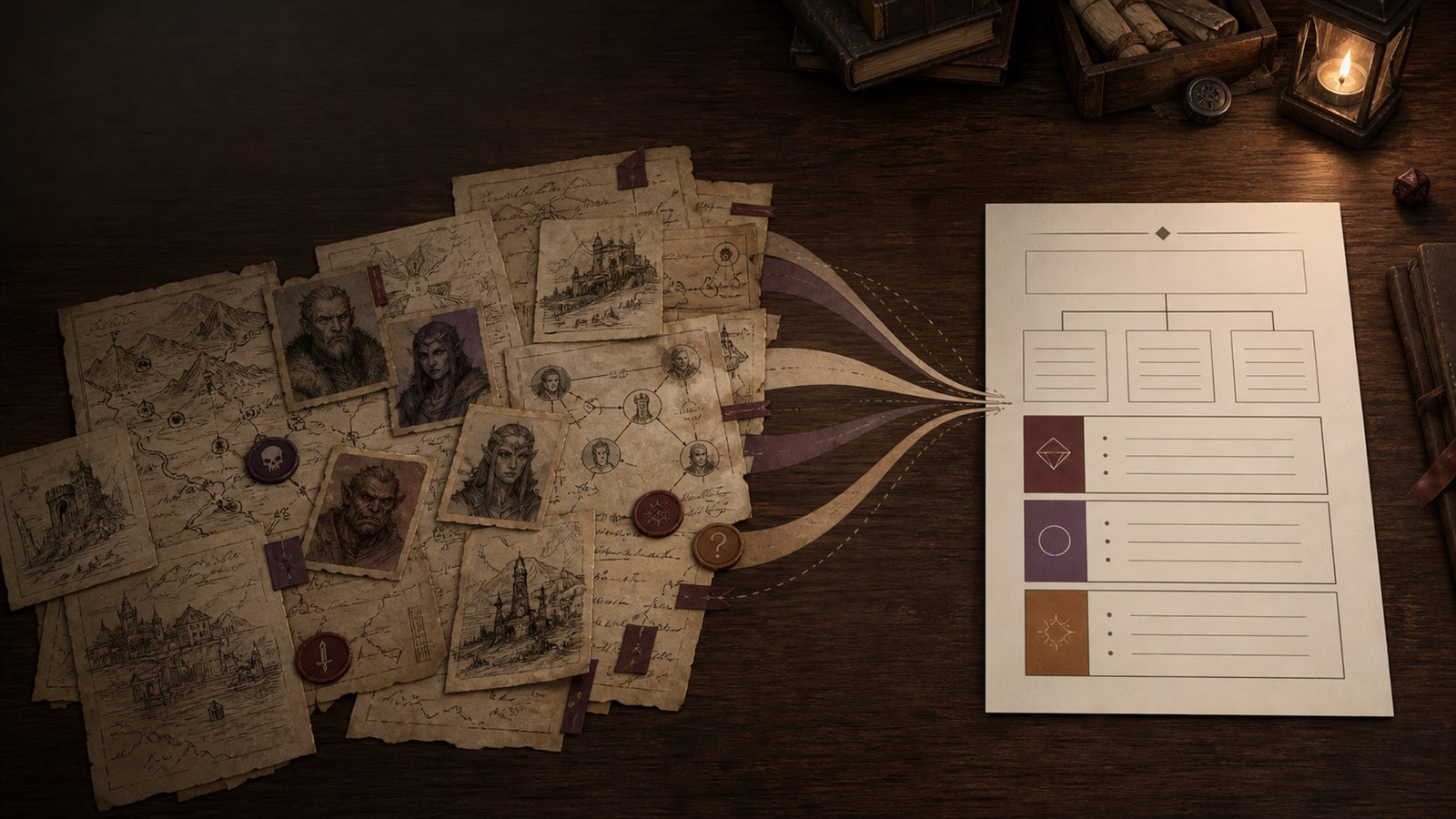
The escaped smuggler is somewhere in the city. A player promised to return a stolen relic. The mayor secretly changed sides. One character has not heard from her missing brother in eight sessions. The party left an imprisoned demon beneath a monastery and then became distracted by a talking sword.
None of these details are missing. They are simply buried.
That is the real continuity problem in a long-running D&D campaign. You do not need more notes. You need a reliable way to identify which parts of your history still exert pressure on the present.
A campaign continuity audit is a short, periodic review that converts old session notes into a usable picture of the campaign now. It reveals unfinished business, changed relationships, delayed consequences, neglected character concerns, and the small number of developments most worth bringing back.
You can complete the audit using paper, index cards, a document, a spreadsheet, a wiki, or campaign-management software. The method matters more than the tool.
What the audit produces
By the end, you should have a one-page continuity brief containing:
- Where the party is and what they are doing.
- Three to seven active campaign threads.
- Important NPC, faction, and location changes.
- Consequences that have not yet appeared.
- Player-character concerns that need attention.
- Contradictions or uncertain facts that need a ruling.
- Two or three developments that may affect the next session.
The purpose is not to summarize your entire campaign. It is to identify the parts of the past that still matter.
When to conduct a continuity audit
You do not need to perform one after every game. Run an audit:
- Every four to six sessions.
- At the end of a major adventure.
- Before returning from a long break—use the campaign re-entry plan first when the table still needs to decide how to resume.
- When preparation starts to feel vague or overwhelming.
- When players are pursuing several different goals.
- Before beginning the final section of a campaign.
- Whenever you catch yourself saying, “I know that happened, but I cannot remember when.”
For a weekly campaign, a monthly audit is usually sufficient. A five-minute post-session update will make the deeper audit much easier, but you can also use this process to rescue a campaign that has never been systematically tracked.
What you need
Gather only the material most likely to affect the current campaign:
- Notes from the last three to six sessions.
- Your previous session-preparation document.
- Your list of important NPCs, factions, quests, or locations, when one exists.
- Player goals, backstories, or stated intentions.
- A blank page for the continuity brief.
The six-part continuity audit
Set a timer for 30 minutes. The time limit is important. Without it, continuity work easily turns into encyclopedia maintenance, map redesign, prose rewriting, or several hours spent correcting the spelling of dead NPCs.
Current Position
3 min
Unresolved Threads
7 min
State Changes
6 min
Unpaid Consequences
5 min
Character Ledger
5 min
What Matters Next
4 min
Final output
One-Page Continuity Brief
Part 1
3 minEstablish the campaign’s current position
Write one or two sentences answering:
- Where is the party?
- What just happened?
- What do the players currently intend to do?
- What immediate danger, deadline, or uncertainty exists?
Use observable facts rather than a broad story summary.
Too broad or predetermined
The party is fighting the Ashen Hand and searching for the Crown of Sorrow.
Useful continuity note
The party ended the session inside the flooded archives beneath Bellweather Abbey. They recovered the Crown of Sorrow, but Captain Vey escaped with the key needed to leave. The players intend to pursue him before the tide returns at midnight.
This statement becomes the anchor for the rest of the audit. Every potential thread will be judged partly by whether it can affect the party’s current position.
Part 2
7 minExtract unresolved threads
Review the recent session notes and mark anything that creates an expectation of future change. Look for:
- Promises and debts.
- Threats and escaped enemies.
- Unanswered questions.
- Unclaimed rewards.
- Missing people.
- Unexplained objects.
- Delayed rituals.
- Political commitments.
- Rumours investigated or ignored.
- Explicit player plans.
- Information an NPC promised to obtain.
- Problems contained rather than solved.
Write each thread as an unresolved situation, not as a predetermined plot.
Too broad or predetermined
Captain Vey attacks the party during the next session.
Useful continuity note
Captain Vey escaped with the abbey key and knows the party possesses the Crown of Sorrow.
The second version preserves the fact without deciding how the campaign must unfold. For each thread, record four fields:
| Field | Question |
|---|---|
| Thread | What remains unresolved? |
| Origin | When or where did it begin? |
| Pressure | What may change if nobody intervenes? |
| Relevance | Why might the players care? |
- Field
- Thread
- Question
- What remains unresolved?
- Field
- Origin
- Question
- When or where did it begin?
- Field
- Pressure
- Question
- What may change if nobody intervenes?
- Field
- Relevance
- Question
- Why might the players care?
| Thread | Origin | Pressure | Player relevance |
|---|---|---|---|
| Captain Vey escaped with the abbey key | Session 18, flooded archives | The tide reaches the lower vaults at midnight | The party may become trapped with the Crown |
| Mira promised to warn the river clans | Session 16, Northgate | The Ashen Hand is recruiting nearby | Connects directly to Mira’s family |
| The black egg beneath the monastery is cracking | Session 12, Saint Orra’s Monastery | Something may hatch without the party present | The party chose containment instead of destruction |
- Thread
- Captain Vey escaped with the abbey key
- Origin
- Session 18, flooded archives
- Pressure
- The tide reaches the lower vaults at midnight
- Player relevance
- The party may become trapped with the Crown
- Thread
- Mira promised to warn the river clans
- Origin
- Session 16, Northgate
- Pressure
- The Ashen Hand is recruiting nearby
- Player relevance
- Connects directly to Mira’s family
- Thread
- The black egg beneath the monastery is cracking
- Origin
- Session 12, Saint Orra’s Monastery
- Pressure
- Something may hatch without the party present
- Player relevance
- The party chose containment instead of destruction
Do not include every unfinished detail. Include threads that meet at least one of these tests:
- A player deliberately pursued it or made a promise about it.
- It threatens something the players value.
- It changes the state of an important person or place.
- It has a natural deadline or can produce a meaningful consequence.
- The table reacted strongly when it appeared.
Part 3
6 minCheck what changed
Campaigns become inconsistent when descriptions remain static after events change the world. Review recent notes for state changes involving NPCs, factions, locations, relationships, ownership, knowledge, goals, resources, reputation, territory, injury, capture, exile, or disappearance. Use a simple before-and-after format.
| Subject | Before | Now | Source |
|---|---|---|---|
| Captain Vey | Party contact | Hostile fugitive | Session 18 |
| Bellweather Abbey | Abandoned | Flooding and occupied by smugglers | Sessions 17–18 |
| Mira and the river clans | Estranged | Mira promised to warn them | Session 16 |
| Crown of Sorrow | Believed destroyed | Carried by the party | Session 18 |
- Subject
- Captain Vey
- Before
- Party contact
- Now
- Hostile fugitive
- Source
- Session 18
- Subject
- Bellweather Abbey
- Before
- Abandoned
- Now
- Flooding and occupied by smugglers
- Source
- Sessions 17–18
- Subject
- Mira and the river clans
- Before
- Estranged
- Now
- Mira promised to warn them
- Source
- Session 16
- Subject
- Crown of Sorrow
- Before
- Believed destroyed
- Now
- Carried by the party
- Source
- Session 18
An NPC entry may still describe Captain Vey as a charming harbourmaster. That remains useful history, but your active brief must show that he is now a hostile fugitive with the only obvious exit key.
Part 4
5 minIdentify unpaid consequences
Players make choices, but not every consequence should appear immediately. A consequence becomes “unpaid” when the campaign has established a likely reaction that has not yet occurred or become visible.
Ask:
- Who benefited, and who lost something?
- Who learned what the party did?
- What continued while the party was elsewhere?
- What resource did the party consume?
- What authority did they defy?
- What danger did they postpone or promise did they neglect?
- Which enemy had time to respond?
The response might be political, personal, logistical, or strange: a humiliated noble’s family reacts; a rescued witness attracts attention; an approaching army advances; an unpaid town guard loses patience; or a faction learns the party possesses an important artifact.
For each unpaid consequence, decide whether it should:
- Develop offstage.
- Appear as a rumour or message.
- Become an immediate complication.
- Wait until the party returns to the affected location.
- Be retired because it no longer improves the campaign.
Retiring a consequence is legitimate. Continuity does not require every action to generate a subplot.
When an active organization should respond between sessions, the 10-minute faction-turn method turns that unpaid consequence into a playable next move.
Part 5
5 minCheck the player-character ledger
Campaign continuity is not only world continuity. It also includes the concerns the players brought into the story. For each player character, write:
- Their current stated goal.
- The last session in which that goal changed or advanced.
- An important unresolved relationship.
- Any promise, fear, secret, or question currently in play.
- Whether the character recently made a consequential choice.
| Character | Current concern | Last advanced | Possible opening |
|---|---|---|---|
| Mira | Reconcile with the river clans | Session 16 | A clan messenger reaches the abbey |
| Torren | Find who forged his military orders | Session 14 | Vey carries a seal from the same office |
| Sen | Control the voice inside the Crown | Session 18 | The Crown recognizes something below the abbey |
| Caldus | Repay the temple that resurrected him | Session 11 | No immediate connection needed |
- Character
- Mira
- Current concern
- Reconcile with the river clans
- Last advanced
- Session 16
- Possible opening
- A clan messenger reaches the abbey
- Character
- Torren
- Current concern
- Find who forged his military orders
- Last advanced
- Session 14
- Possible opening
- Vey carries a seal from the same office
- Character
- Sen
- Current concern
- Control the voice inside the Crown
- Last advanced
- Session 18
- Possible opening
- The Crown recognizes something below the abbey
- Character
- Caldus
- Current concern
- Repay the temple that resurrected him
- Last advanced
- Session 11
- Possible opening
- No immediate connection needed
The purpose is not to force equal attention into every session. It is to notice accidental neglect. Caldus does not necessarily need temple material next week. But if his concern remains untouched for another six sessions, that should be a conscious choice rather than an omission.
Part 6
4 minSelect what matters next
You now have more possible material than you should prepare. Choose no more than three continuity elements that may affect the next session:
- One immediate element connected to where the party left off.
- One returning element from an earlier session.
- One character element connected to a player’s concern.
- Immediate
- The tide is filling the archive and Vey has the exit key.
- Returning
- The Crown reacts to the black egg first discovered beneath the monastery.
- Character
- The seal on Vey’s documents connects to Torren’s false orders.
These are not three mandatory encounters. They are three pieces of campaign history available to shape what happens. Continuity should make the world feel responsive, not make the campaign feel railroaded.
The completed continuity brief
A finished brief might look like this:
Current position
The party is trapped in the flooded archives beneath Bellweather Abbey after recovering the Crown of Sorrow. Captain Vey escaped with the exit key. The tide reaches the lower vaults at midnight.
Active threads
- Vey escaped with the abbey key.
- Mira promised to warn the river clans.
- The black egg beneath Saint Orra’s Monastery is cracking.
- Torren’s forged orders remain unexplained.
- The Ashen Hand is recruiting in the river settlements.
Important changes
- Vey is now openly hostile.
- Bellweather Abbey is flooding.
- The Crown is in the party’s possession.
- The smugglers have lost their abbey base.
- Mira has re-established contact with her clan.
Unpaid consequences
- The harbour authority will discover Vey’s operation.
- The Ashen Hand knows the Crown has been recovered.
- The river clans may act without waiting for Mira.
- The monastery threat has had six more days to develop.
Character check
- Mira’s family thread advanced two sessions ago.
- Torren’s mystery has been inactive for four sessions.
- Sen’s Crown connection is immediately relevant.
- Caldus’s temple debt can remain dormant.
Material for the next session
- The tide and missing key create immediate pressure.
- Vey possesses a seal connected to Torren’s forged orders.
- The Crown reacts to something beneath the abbey that resembles the monastery egg.
That is enough continuity information to begin preparing.
How to classify campaign threads
Not all open threads deserve equal attention. Give each one a simple status: Hot, Warm, Sleeping, Resolved, or Retired.
Hot
Can affect the next session
Vey has the exit key and the archive is flooding.
Warm
Relevant, with no immediate pressure
Mira promised to warn the river clans.
Sleeping
Valid, but currently inactive
Caldus owes a debt to the temple.
Resolved
The central question is answered
The party discovered who poisoned the duke.
Retired
Deliberately removed from future planning
The merchant’s silver ring will remain flavour.
The Retired status is essential. Without it, every improvised detail becomes permanent narrative debt. A rich campaign produces more possible stories than it can use. Good campaign management includes deciding what no longer needs attention.
Plot thread, fact, or flavour?
Dungeon Masters often overload their thread list because they classify every memorable detail as an unresolved plot. Use this test:
Fact
Describes something currently true.
The Western Gate is controlled by the Ashen Hand.
Flavour
Makes the world vivid without creating an expectation of resolution.
Green lanterns burn throughout the harbour district.
Thread
Contains an unresolved question, pressure, obligation, or expected change.
The Ashen Hand seized the Western Gate after learning the party was approaching.
The green lanterns can become a thread later, but they are not one merely because the players noticed them.
Common continuity mistakes
Rereading every session before preparing
This feels responsible but scales badly. Start with recent sessions, extract active developments, and follow older references only when necessary.
Writing long summaries instead of recording changes
A thousand-word recap can still hide the one fact that matters: the queen now believes the party betrayed her. Record changes explicitly.
Treating every unresolved detail as equally important
A campaign with 40 “active” threads has no active-thread system. Use Hot, Warm, Sleeping, Resolved, and Retired.
Recording the world but not the characters
A flawlessly tracked conspiracy does not compensate for forgetting what the player characters care about. Include a short character ledger.
Deciding the outcome while recording the thread
Write “Mira warned the river clans, who may now intervene,” not “The river clans arrive and rescue Mira.” Track the unresolved situation; decide its expression during preparation or play.
Keeping the original state but not the current state
“The friendly harbourmaster” and “the fugitive who stole the key” may describe the same NPC at different times. Keep history, but make the present state obvious.
Never retiring anything
Continuity does not require you to revive every joke, shopkeeper, rumour, and improvised symbol. Retiring weak material protects the stronger material.
The five-minute post-session update
A continuity audit is easier when each session ends with a tiny processing step. After the players leave, record only:
- Where the party ended.
- What changed.
- What remains unresolved.
- What the players said they intend to do.
- One consequence likely to develop.
- Ending position
- Flooded archives beneath Bellweather Abbey.
- Changed
- The party recovered the Crown; Vey became hostile and escaped.
- Unresolved
- Exit key, rising tide, and the identity of Vey’s patron.
- Player intention
- Catch Vey and leave before midnight.
- Developing consequence
- The Ashen Hand learns the Crown has resurfaced.
This takes less time than writing a polished recap and gives the next continuity audit exactly what it needs. For a fuller repeatable version, use the 15-minute D&D session-notes template.
A reusable campaign continuity template
Copy this into your preferred notes system.
Current position
Where is the party, what just happened, and what do they intend to do?
Active threads
Thread · Origin · Pressure · Player relevance · Status
Important state changes
Subject · Previous state · Current state · Source session
Unpaid consequences
Cause · Likely response · Timing · Keep, delay, or retire
Character ledger
Character · Current concern · Last advanced · Unresolved connection
Continuity elements for the next session
Immediate · Returning · Character-related
Contradictions or rulings needed
Record uncertain facts that need a deliberate decision.
Optional next step
Automating the continuity work
When finding and reconnecting campaign history becomes the slow part, Forge can help you:
- Preserve your original Session notes.
- Review proposed Encounters and connections.
- Ask Campaign questions with links to supporting history.
You still decide what is true, what matters, and what happens next.
Explore campaign memoryContinuity is selection, not perfect memory
You will never remember or use everything created during a long campaign. That is not a failure.
A campaign becomes coherent because important choices leave traces, people respond to what happened, relationships change, and selected elements return at meaningful moments.
The goal of continuity work is to distinguish:
- What is true now.
- What is still in motion.
- What the players care about.
- What can be allowed to sleep.
- What should be retired.
- What deserves to return next.
Thirty focused minutes can give you that picture without requiring you to rebuild your entire note system.