
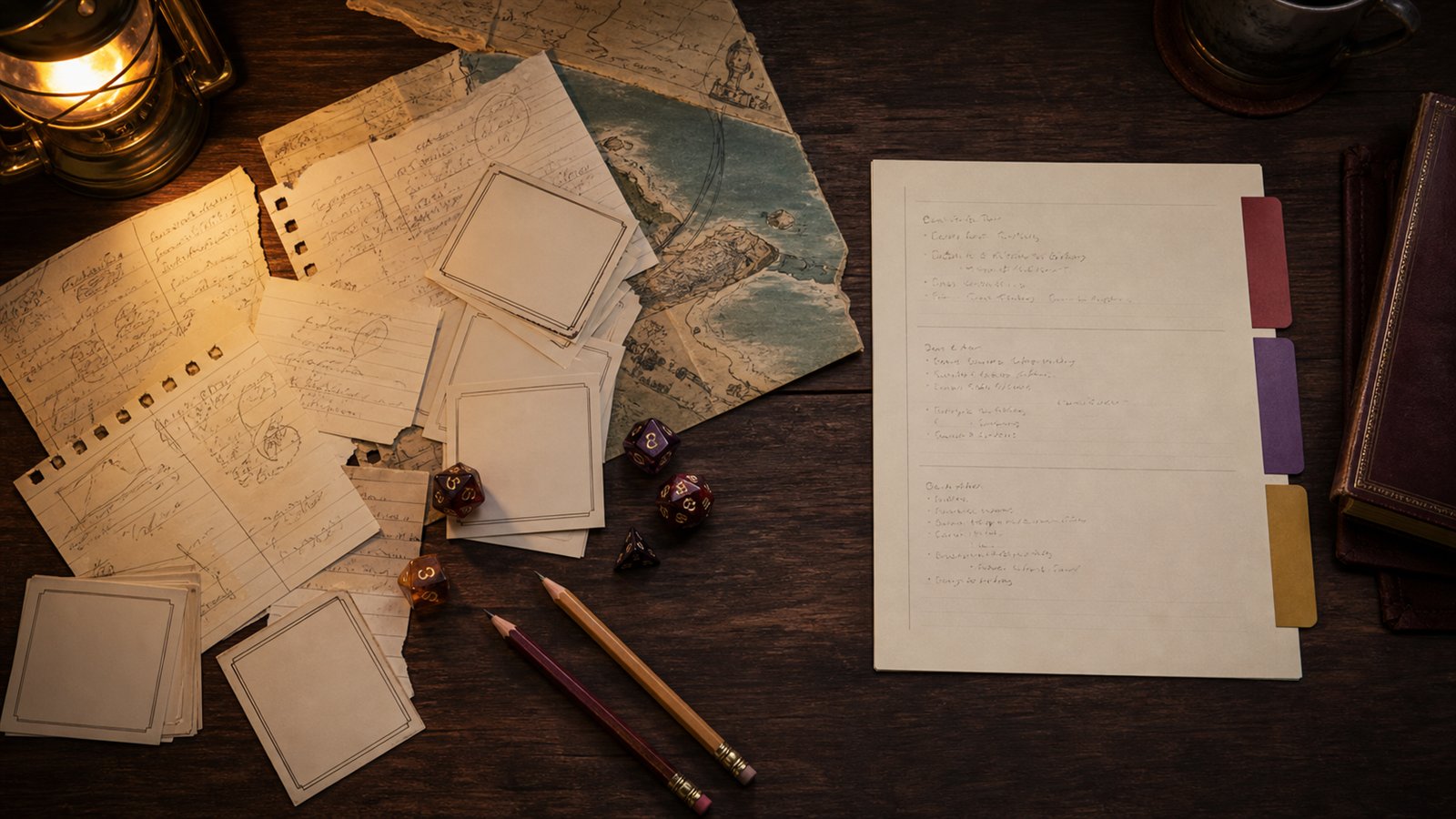
You finish a great session. The party made a deal with a suspicious guide, gave a cursed ring to an NPC, angered a local guild, and announced that they are sailing north next week.
guide = 40 gp? knows smugglers / ring to Ilyra / guild mad / NORTH
That is not bad note-taking. It is exactly what a live game produces: useful fragments written while you are listening, ruling, roleplaying, and keeping the table moving.
The problem begins later. If those fragments stay as fragments, next week's prep starts with reconstruction: What did Ilyra promise? Which guild? Was north a plan or a joke? After enough sessions, the campaign becomes a pile of recaps that is technically complete but difficult to use.
This template gives every session three outputs:
- Record: what became true at the table.
- Pressure: what is still moving, unresolved, or likely to react.
- Prep: the few things worth making ready for the next session.
You can use it in a notebook, a document, a wiki, or on index cards. The format matters less than the separation.
Why a recap alone is not enough
A recap answers, “What happened?” That is essential, but it asks one question too few.
Good campaign management also needs to answer:
- What changed because of it?
- Who knows, wants, fears, or owes something new?
- What has a clock on it?
- What did the players say they want to do next?
- What can I prepare without deciding the players' choices for them?
If you mix all of those into one running paragraph, future-you has to interpret every line again. The Record → Pressure → Prep method gives each kind of information a home and makes the next decision easier.
The 15-minute post-session workflow
Do this after the session or the next morning, while the table is still fresh. Set a timer. The goal is not perfect documentation; it is a usable handoff to your future self.
1. Record
What became true
Facts, not predictions
2. Pressure
What may move
Consequences, not scripts
3. Prep
What to make ready
Responses, not a route map
Step 1
Minutes 0–4Preserve the raw record
First, save the notes exactly as they were written. Do not clean them up while you are trying to remember the whole night. Raw notes contain timing, wording, and uncertainty that a polished recap can accidentally erase.
Then write a four-to-six-bullet factual recap. Use past-tense verbs and include only things that happened or were established at the table.
Example: factual recap
- The party accepted guide Mara Venn's offer to take them through the Salt Marches for 40 gp and safe passage.
- Tovin gave the black ring to Ilyra at the Lantern House.
- Guild factor Harrold publicly blamed the party for the warehouse fire.
- The party learned that a smuggler vessel leaves Greywake in six days.
- The group ended the session intending to find passage north.
Step 2
Minutes 4–8Update the change log
List only the things whose current state changed. This is the part most recaps bury, and it is why a returning NPC or location can feel inconsistent months later. Use five headings and leave any empty.
| Area | Ask | Example update |
|---|---|---|
| People | Who gained, lost, learned, promised, or changed position? | Mara is hired by the party; Harrold is openly hostile; Ilyra possesses the black ring. |
| Factions | What did an organization gain, lose, learn, or decide? | The Dockside Guild believes the party caused the fire. |
| Places | What became unsafe, accessible, altered, or newly relevant? | The Lantern House is linked to the ring; Greywake has a six-day departure clock. |
| Things | What changed hands, was spent, damaged, revealed, or identified? | The black ring moved from Tovin to Ilyra. |
| Knowledge | Who learned a clue, secret, name, or belief? | The party knows the smuggler route may lead north. |
- Area
- People
- Ask
- Who gained, lost, learned, promised, or changed position?
- Example update
- Mara is hired by the party; Harrold is openly hostile; Ilyra possesses the black ring.
- Area
- Factions
- Ask
- What did an organization gain, lose, learn, or decide?
- Example update
- The Dockside Guild believes the party caused the fire.
- Area
- Places
- Ask
- What became unsafe, accessible, altered, or newly relevant?
- Example update
- The Lantern House is linked to the ring; Greywake has a six-day departure clock.
- Area
- Things
- Ask
- What changed hands, was spent, damaged, revealed, or identified?
- Example update
- The black ring moved from Tovin to Ilyra.
- Area
- Knowledge
- Ask
- Who learned a clue, secret, name, or belief?
- Example update
- The party knows the smuggler route may lead north.
This is not a full encyclopedia. Capture only changes that could matter later. A tavernkeeper's name can stay in the raw record until it matters; the identity of the person holding a dangerous artifact should not.
Step 3
Minutes 8–11Make a pressure list, not a plot outline
The pressure list contains things that may move if the players do nothing: unresolved questions, promises, threats, opportunities, and consequences. Keep it short, active, and testable.
When a pressure belongs to a character concern, the player spotlight tracker helps turn it into an optional, group-friendly invitation.
| Field | What to write |
|---|---|
| Pressure | A plain-language situation, not a vague label. |
| Source | The session or event that created it. |
| Clock | When it changes, if it has one. |
| Likely move | What happens if the party does not intervene. |
| Next evidence | The clue, NPC action, rumor, or scene that could reveal movement. |
- Field
- Pressure
- What to write
- A plain-language situation, not a vague label.
- Field
- Source
- What to write
- The session or event that created it.
- Field
- Clock
- What to write
- When it changes, if it has one.
- Field
- Likely move
- What to write
- What happens if the party does not intervene.
- Field
- Next evidence
- What to write
- The clue, NPC action, rumor, or scene that could reveal movement.
Example pressure list
| Pressure | Source | Clock | Likely move | Next evidence |
|---|---|---|---|---|
| Harrold wants someone to pay for the warehouse fire. | Session 18 | None yet | Guild agents look for leverage, not necessarily a fight. | A friend warns the party that the guild is asking questions. |
| The black ring is with Ilyra. | Session 18 | Three nights | Its influence becomes visible around her. | Ilyra misses an appointment; her room smells of seawater. |
| A smuggler ship leaves Greywake. | Session 18 | Six days | The route closes or costs more to access. | A dockworker posts the sailing schedule. |
- Pressure
- Harrold wants someone to pay for the warehouse fire.
- Source
- Session 18
- Clock
- None yet
- Likely move
- Guild agents look for leverage, not necessarily a fight.
- Next evidence
- A friend warns the party that the guild is asking questions.
- Pressure
- The black ring is with Ilyra.
- Source
- Session 18
- Clock
- Three nights
- Likely move
- Its influence becomes visible around her.
- Next evidence
- Ilyra misses an appointment; her room smells of seawater.
- Pressure
- A smuggler ship leaves Greywake.
- Source
- Session 18
- Clock
- Six days
- Likely move
- The route closes or costs more to access.
- Next evidence
- A dockworker posts the sailing schedule.
The phrase likely move matters. It lets the world react without promising a single scene. Players can negotiate with Harrold, flee town, frame someone else, or ignore him; your preparation should support consequences, not force a route.
Step 4
Minutes 11–15Write a one-page next-session brief
Prep only the next useful layer. A strong brief gets you to the table with direction while leaving players room to surprise you.
Next-session brief template
SESSION [number] — NEXT-SESSION BRIEF

Where play resumes:
[Place, immediate situation, and who is present.]

Opening pressure:
[One sensory or social signal that makes the current situation move.]

What the players said they may do:
1. [Intention]
2. [Intention]
3. [Intention, if any]

Three prepared responses (not required scenes):
1. [If they pursue the most likely direction...]
2. [If they investigate or negotiate...]
3. [If they change direction...]

People/places to have ready:
- [Name]: [current goal, leverage, or attitude]
- [Location]: [what has changed or what it can reveal]

One reveal or decision point:
[Information that becomes available if the players earn, notice, or ask for it.]

Stop prep here:
[The boundary that prevents you from writing the party's choices in advance.]
Filled example
Completed next-session brief
SESSION 19 — NEXT-SESSION BRIEF

Where play resumes:
Outside the Lantern House at dawn. Ilyra has not come downstairs.

Opening pressure:
Saltwater drips from beneath Ilyra's door while two Dockside Guild agents question the innkeeper.

What the players said they may do:
1. Check on Ilyra.
2. Find a ship north.
3. Deal with the guild before leaving town.

Three prepared responses:
1. The ring's influence has pulled Ilyra toward the flooded cellar; it offers clues, not a mandatory fight.
2. The smuggler captain wants a favor or a false manifest before offering passage.
3. Harrold will accept restitution, a scapegoat, or useful information; violence is his costly option.

People/places to have ready:
- Mara Venn: wants the job but will not cross the Guild for free.
- Greywake docks: departure board, a nervous deckhand, Guild eyes.

One reveal or decision point:
The ring belonged to a drowned customs officer who investigated the smuggler route.

Stop prep here:
Do not decide whether the party boards the ship, gives up the ring, or fights the Guild.
The complete session-notes template
Use this as a standing page for every session.
Complete session-notes template
# Session [number]: [short title]
Date played: [date]

## Raw table notes
[Keep the messy notes, initiative scraps, and exact wording worth preserving.]

## Record: what became true
-
-
-

## Change log
### People
-
### Factions
-
### Places
-
### Things
-
### Knowledge
-

## Pressure list
| Pressure | Source | Clock | Likely move | Next evidence |
|---|---|---|---|---|
| | | | | |

## Player-facing recap (optional)
[What the characters would reasonably know; omit GM-only causes, clocks, and future moves.]

## Next-session brief
### Where play resumes

### Opening pressure

### Player intentions
1.
2.
3.

### Three prepared responses
1.
2.
3.

### People/places to have ready
-

### One reveal or decision point

### Stop-prep boundary

## After the next session
[Move resolved pressures to the record; update only what changed.]
Session 18
One working session page
Raw notes
Record
Change log
Pressure list
Next-session brief
Keep facts, interpretation, and prep separate
This is the rule that protects both continuity and player agency.
| Category | Example | How to handle it |
|---|---|---|
| Fact | “The party gave Ilyra the ring.” | Put it in the Record and change log. |
| Interpretation | “Ilyra is probably in danger.” | Put it in Pressure only if the world gives it a cause. |
| DM possibility | “The ring might call something from the sea.” | Keep it in private prep, not campaign history. |
| Player intention | “We’ll sail north next time.” | Put it in the brief; treat it as a lead, not a contract. |
- Category
- Fact
- Example
- “The party gave Ilyra the ring.”
- How to handle it
- Put it in the Record and change log.
- Category
- Interpretation
- Example
- “Ilyra is probably in danger.”
- How to handle it
- Put it in Pressure only if the world gives it a cause.
- Category
- DM possibility
- Example
- “The ring might call something from the sea.”
- How to handle it
- Keep it in private prep, not campaign history.
- Category
- Player intention
- Example
- “We’ll sail north next time.”
- How to handle it
- Put it in the brief; treat it as a lead, not a contract.
If an interpretation later proves wrong, nothing has been retconned—you simply had a possibility, not a fact. If players change their minds, you still have a prepared response instead of a wasted script.
Common mistakes that make notes harder to use
Writing a beautiful recap and no next action
An elegant page can still fail at prep time. End every session note with a next-session brief, even if it contains only an opening pressure and two names to review.
Turning every mention into a tracked entity
Over-capture creates maintenance work. Promote details when they change state, create a choice, reveal a relationship, or are likely to recur. Keep everything else searchable in the raw record.
Treating every open thread as equally urgent
Sort pressures by what will move soon, what the players care about, and what can create a meaningful choice now. A campaign does not need ten active fronts at once.
Preparing scenes as a route map
Three prepared responses are not three required scenes. Prepare people, places, motives, clues, and consequences. Let the table choose the order.
Rewriting history after every session
Preserve the original notes. Corrections and later revelations should be additions to the record, not silent replacements for what the table understood at the time.
If you missed a few updates
Do not begin with the entire campaign. Pick the last session you can confidently reconstruct, run the template for it, and work forward only until you have a usable current brief. Then use the 30-Minute D&D Campaign Continuity Audit to find the important threads and state changes that deserve backfilling.
The goal is not an immaculate wiki. It is a campaign you can resume with confidence.
Automating the workflow, while keeping DM judgment
Once this manual method works, the repetitive part is connecting the record to the people, places, factions, and events it establishes. DMForge can preserve the notes you already keep, propose Encounters and connections for review, and connect the history you approve. You remain the authority over canon.
Start a free campaignMake the second pass the useful one
The notes you take during play do not need to be elegant. They need a short second pass that separates what happened, what is now moving, and what you will prepare next. Make that pass a 15-minute habit, and every session leaves the campaign easier—not harder—to run.
Keep the raw record. Update only what changed. Prep only what helps the next decision.