
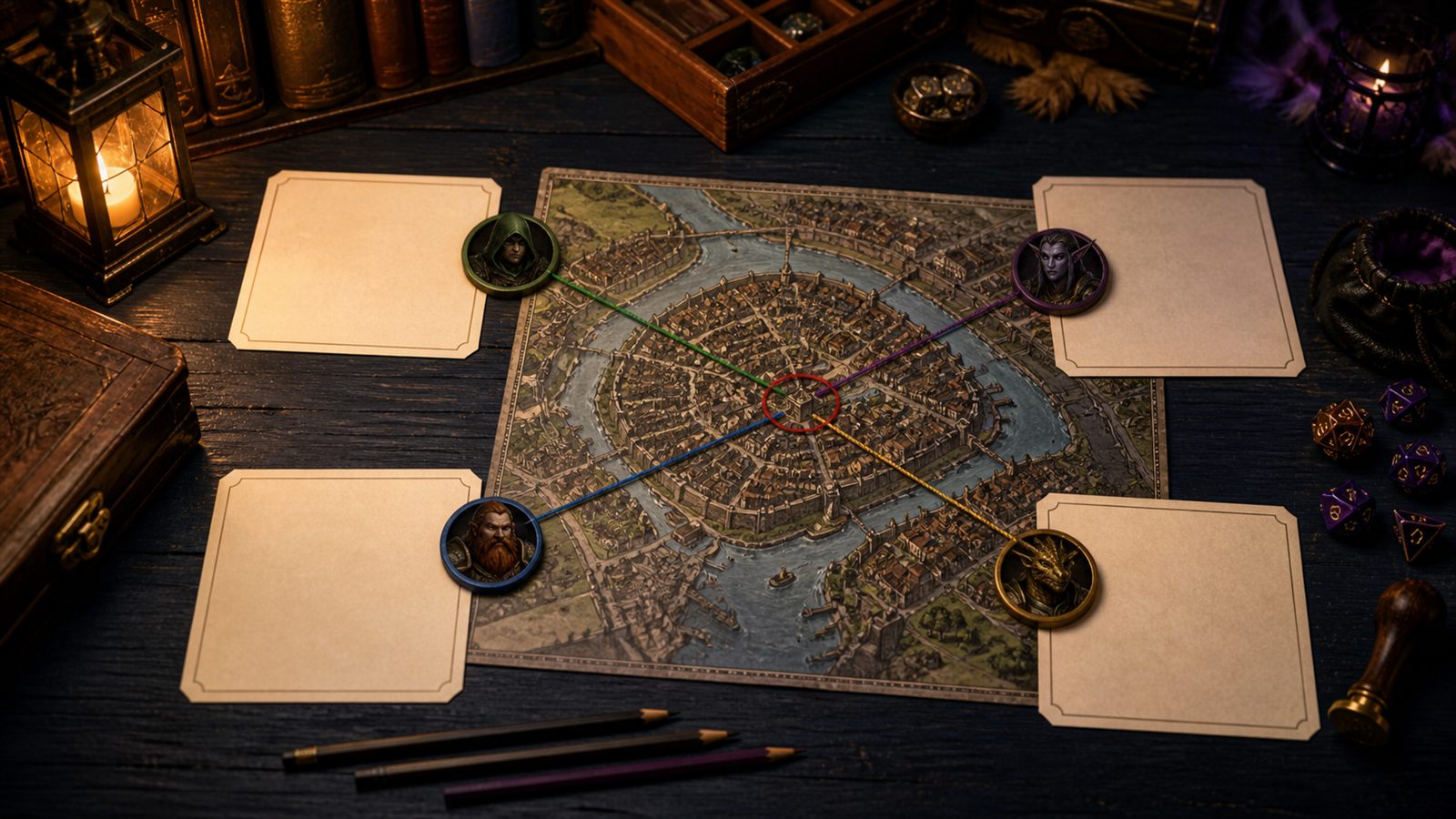
When a campaign has been running for a while, player backstories can become a strange kind of homework.
You remember that Rook is hunting the mage who ruined her family. You remember that Brother Cal wants to restore his disgraced temple. You remember that the group found a letter connected to both of them. But when it is time to prepare Saturday’s game, the immediate dungeon, map, monsters, and main plot are louder than those facts.
No one intends to neglect a character. One player gets hooks because their goal is easy to see. Another waits six sessions for the part of the campaign they said they cared about. Meanwhile, pressure to “give everyone a spotlight” can turn into personal quests with predetermined endings.
You do not need a quota, a color-coded novel, or a separate adventure for every character. You need a short record of the promises currently alive in the campaign and one possible way each promise could touch play.
Track live promises, not every detail in a character biography.
This player spotlight tracker takes about ten minutes before a session. It works on paper, in a note, or in a spreadsheet. It does not decide what the players do. It helps you remember which choices would matter to them.
What a spotlight is, and what it is not
A spotlight is a moment when a character has a meaningful decision, expression, competence, relationship, or consequence that other players can respond to.
It is not:
- Equal minutes of speaking time every session.
- A solo cutscene that stops the table.
- A reward for the player who writes the longest backstory.
- A hidden “correct” decision that advances a prewritten character arc.
Some sessions will naturally favor the ranger in the wilderness, the bard at a negotiation, or the cleric at a ruined shrine. Fairness over a campaign means everyone receives meaningful opportunities over time, not that every session is divided into identical slices.
The useful prep question is:
What could happen next that lets this character make a choice or show us what matters to them?
Build a four-field player spotlight tracker
Give each player character one row. Keep the entries short enough to scan while you prepare.
Live promise
What has the player shown they care about right now?
Asha will not leave her former crewmate on the prison hulk.
Pressure
What is changing, threatened, delayed, or asking for action?
The prison hulk sails at dawn.
Invitation
What choice, clue, cost, or ally could appear?
A dockworker offers a watch schedule in exchange for a favor.
Outcome
What changed that should shape the next appearance?
Asha declined the deal, so the map went to a rival captain.
1. Live promise: track what is active
A live promise is an unresolved concern that has shown up in play: a person the character protects, a belief they defend, a debt, a mystery, a rival, a place they want to change, or an ambition they have acted on.
“Asha was raised by pirates” is background. “Asha promised not to leave her former crewmate in the prison hulk” is a live promise.
Use evidence from the table. Players reveal priorities through choices, questions, recurring jokes, NPCs they seek out, and risks they accept. If you are guessing, keep the entry tentative and ask after the game instead of building a whole arc around it. The campaign continuity audit can help you find unresolved concerns from earlier sessions.
| Background fact | Live promise |
|---|---|
| Neris is from a noble family. | Neris wants proof that her brother did not betray the city. |
| Torren served in a border war. | Torren will not abandon the refugees at the old fort. |
| Ilyra studies forbidden magic. | Ilyra wants access to the observatory, but refuses to serve its former master. |
Start with one promise per character. More is not better; a crowded tracker becomes another place to lose the thread.
2. Pressure: make the promise move
Pressure makes “someday” relevant now. A deadline, rival, cost, consequence, offer, rumor, or change in circumstance will do.
Good pressure creates motion while leaving several responses open:
- The prison hulk sails at dawn.
- The refugees’ food will last three days.
- A rival offered the observatory’s curator a safer deal.
- The brother’s signet appears at a crime scene.
Avoid pressure that secretly requires one solution. Establish the danger and let the group decide whether to bargain, infiltrate, seek help, make a trade, or walk away. If an NPC drives the pressure, an NPC’s current goal can give the situation an honest next move.
3. Invitation: prepare an opening, not a required scene
An invitation is the playable form of the pressure. It can be a person, evidence, obstacle, opportunity, or difficult question that appears in the session you are already preparing.
For Asha, the prison hulk might dock beside the party’s planned destination. A former crewmate offers a map in exchange for a dangerous favor. A guard recognizes Asha’s tattoo. None requires the party to abandon its current plan, but each makes her promise available to play.
Choice
Two worthwhile priorities conflict.
Cost
Help consumes time, money, safety, or trust.
Clue
New evidence changes what the character believes.
Relationship
An ally, rival, or dependent asks for something.
Competence
The situation rewards a character’s distinctive approach.
Consequence
A previous decision returns in concrete form.
Write one sentence, then stop. The guide to preparing situations rather than outcomes offers a fuller framework for the scene around it.
4. Outcome: record the new truth
After the session, update one line per character who had a meaningful interaction. Record a change in the campaign, not a judgment about whether the player “took the hook.”
- Asha: Declined the crewmate’s deal; the map went to the rival captain.
- Neris: Cleared her brother’s name with the watch, but exposed the family’s hidden accounts.
- Torren: Persuaded the refugees to move; the old fort is now empty and vulnerable.
This is how a spotlight becomes continuity. Next time, you do not need to remember the whole conversation. You know the current fact that should shape the world’s response. Update that outcome in your next-session brief.
A worked example: one session, four characters
Imagine the party is traveling to the river city of Veyrun to investigate disappearances. The main plot is already strong. The tracker does not replace it; it looks for natural points of contact.
| Character | Live promise | Pressure | Invitation |
|---|---|---|---|
| Asha, rogue | Save a former crewmate held on the prison hulk. | The hulk leaves at dawn. | A dockworker offers a watch schedule for a favor. |
| Neris, paladin | Clear her brother’s name. | His signet is found on a victim. | The investigator assumes the family is involved. |
| Torren, fighter | Protect war refugees. | A local gang is extorting the refugee camp. | The gang blocks the party’s shortest route to the case. |
| Ilyra, wizard | Reach the sealed observatory. | Its curator is selling access. | A buyer needs an object retrieved from the same district. |
Notice what is missing: a timetable for whose scene comes first, a required answer, and an assumption that every invitation will be pursued. The main investigation can remain the session. These entries give you four prepared ways for player priorities to collide with the city.
At the table, two invitations may combine. The gang might transport prisoners to the hulk, making Asha’s and Torren’s concerns one group decision. That is better than separating everyone into private side quests.
Use a light rotation, not a spotlight quota
Before preparing, scan the past two or three sessions. Mark characters who had a meaningful decision or consequence, not merely a successful skill check.
- Prioritize a player who has been quiet in the campaign’s recent arc.
- Add one strong invitation for that character if it fits the next session.
- Add one secondary invitation only when it connects naturally to the same location, NPC, or pressure.
- Let the table’s choices determine whether either becomes play.
This keeps the most vocal player’s goals from becoming the default campaign without stuffing four unrelated personal plots into one evening.
Connect individual spotlights to group choices
The strongest personal material gives the whole party something to care about. Before using an invitation, ask:
- Can another character have an opinion, cost, or opportunity here?
- Does this reveal something about the shared campaign, not only private backstory?
- If the party says no, can the world move in an honest and interesting way?
If the answer is no to all three, keep the idea for a between-session message, downtime scene, or later game. It may be a good character moment but poor table material.
Asha’s promise
Save her former crewmate.
Current pressure
The hulk leaves at dawn.
Shared invitation
A dockside opportunity touches the party’s city investigation.
The group chooses
The world changes
Record the consequence.
“Neris receives a letter from her aunt” is private information. “Neris’s aunt asks the party to hide a witness whose testimony could clear Neris’s brother but ignite a feud” is a group situation. It centers Neris’s concern while leaving every player with agency.
A ten-minute player spotlight prep routine
Use this sequence after choosing the main situation for the next game.
- 1
Read the last outcome
Look for the changed fact for each character, not every old note. - 2
Circle one or two live promises
Choose promises that touch the next location, antagonist, time pressure, or theme. - 3
Write a pressure
Make it observable or discoverable. Do not predetermine a response. - 4
Write one invitation
A clue, cost, choice, relationship, competence moment, or consequence is enough. - 5
Check the group connection
Add an opinion, cost, or opportunity for someone else. - 6
Update outcomes after play
One clear sentence is enough to preserve the new truth.
If a promise has not appeared for several sessions, keep it alive with a small signal: a rumor, changed price, NPC message, altered map, or consequence seen at a distance. A signal says “this still matters in the world” without demanding an immediate detour.
Common spotlight mistakes, and what to do instead
Treating every biography detail as a promise
Do instead: Track what the player has made active through play. Follow engagement, not word count.
Making the invitation a command
Do instead: Put pressure or opportunity before the group and preserve more than one response.
Forcing equal spotlight every session
Do instead: Look for balance across several sessions, then notice who has been waiting too long.
Resolving a promise as soon as it appears
Do instead: Let the concern change shape. Actions can create debts, allies, rivals, and new consequences.
Storing the tracker somewhere you never open
Do instead: Keep it beside your next-session brief. Archive old outcomes and leave only live promises on the working page.
Copyable player spotlight tracker
Make one card per player character. During preparation, circle only the one or two invitations that fit the upcoming session.
NEXT SESSION: ____________________     DATE: ____________________

MAIN SITUATION / LOCATION:
_______________________________________________________________

CHARACTER: ______________________
Live promise:
_______________________________________________________________
Pressure now:
_______________________________________________________________
One possible invitation:
_______________________________________________________________
What other PCs could care about:
_______________________________________________________________
Outcome after play:
_______________________________________________________________

Repeat one card per player character. During prep, circle only the one or two
invitations that fit this session. Keep the remaining cards for later.
For adjacent campaign-planning worksheets, see the Sly Flourish workbook fill-in pages.
Automate the memory, not the choices
This tracker works with index cards or a single document. The manual burden grows when evidence for a live promise is spread across months of session notes, NPC appearances, relationships, and locations.
DMForge preserves the original session record, lets you review the encounters and references Forge finds, and keeps approved campaign history connected to its people, places, events, and relationships. Ask Forge can link an answer back to supporting campaign material, making it easier to recover what changed around a character’s concern.
The creative decision remains yours: which promise is live, what pressure is fair, and whether an invitation belongs in the next session.
Explore Dungeon Masters ForgeKeep the next promise in view
Player spotlights do not come from memorizing every character sheet or scheduling a private quest for everyone. They come from remembering the few promises that are alive, putting honest pressure on them, and offering choices the whole table can engage with.
Keep the tracker small. Update the outcome. Then let the players show you which promise matters next.