
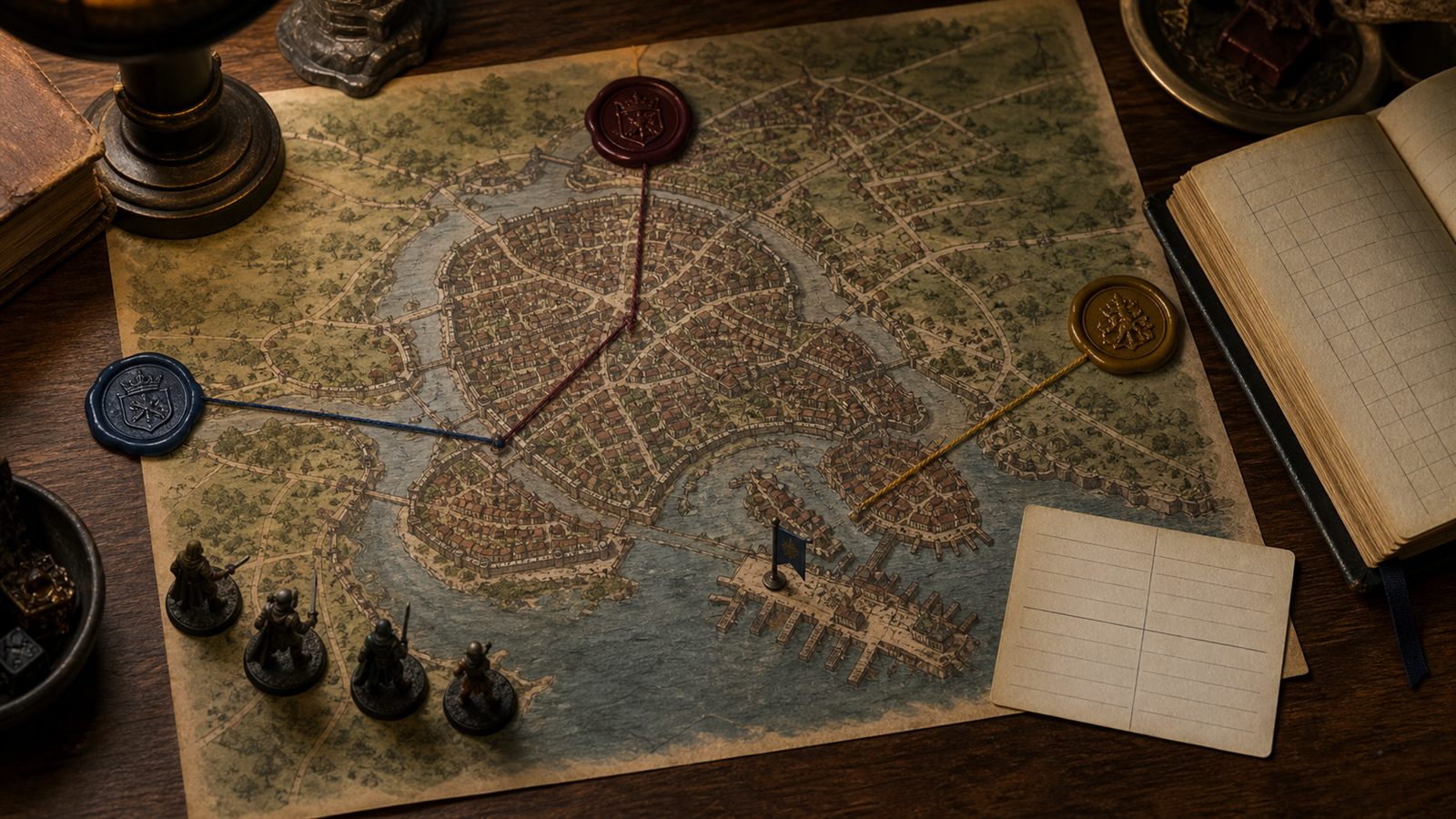
Your players decide not to investigate the merchant prince this week. They head into the hills instead. That is not a dead end for the merchant prince.
He still has debts to collect, allies to call, and a reason to notice that the party left town.
The question is how much of that you should prepare. A full secret agenda for every group turns campaign prep into a second job. If nothing happens until the party touches it, the world pauses politely off-screen.
A faction turn produces the next situation in the world, not a fixed future.
Once between sessions, spend ten minutes deciding what a few active groups attempt, what changes because of it, and how the party might notice. Then leave an opening for the players to alter what happens next.
What a faction turn is—and what it is not
A faction turn is a brief check-in for groups that can change the campaign: noble houses, guilds, cults, militias, criminal crews, churches, expeditions, rival adventurers, or a village council.
For each active faction, answer four questions:
- What do they want now?
- What can they do before the next session?
- What changes if nobody stops them?
- What signal might reach the party?
That is enough. You do not need every detail of the plan, the party’s likely countermeasure, or a simulation of the kingdom’s economy. The turn is a prep tool. It produces situations the party can notice and answer.
Start with only three active factions
Do not run turns for every named organization. Choose groups that meet all three conditions:
- They want something that could change in the next few sessions.
- They have the means to act.
- Their action could reach the party, a place the party cares about, or the campaign’s current question.
Everything else can stay dormant. A faction may exist without producing a new complication every week.
Use the Want, Move, Mark, Signal method
Give each active faction four short lines. Keep them beside your session prep, then add one final player-agency check.
Want
What concrete result do they want next?
Win three captains before the council meets.
Move
What do they attempt if no one intervenes?
Offer Captain Sorel debt relief for an oath.
Mark
What changed fact does the attempt leave?
Sorel’s ships fly Veyr colors at the docks.
Signal
How can that change reach the party?
A dockworker asks why Sorel sold out the city.
Player Opening
What can the party still influence, protect, expose, trade for, or refuse? Their response rewrites the next turn.
Want: name a result, not a personality
Use a concrete near-term objective. “House Veyr wants power” cannot meaningfully succeed or fail. “House Veyr wants three undecided river captains to back its claim before the council meets” can.
The same distinction applies to individuals. The guide to NPC motivations that create choices can help when one person drives the faction’s agenda.
Move: write an attempt, not a victory
Ask what the faction tries if the party does nothing. “House Veyr offers debt relief to Captain Sorel in exchange for a public oath” creates a situation. “House Veyr controls the captains now” removes the chance to intervene.
Mark: record the changed fact
The move should leave something durable: a changed relationship, new resource, damaged place, public rumor, missed deadline, shifted allegiance, or person now in danger. Sorel’s ships flying Veyr colors is a mark you can bring back later.
Signal: give the change a route into play
The party does not automatically know what happened. Let a dockworker ask why Sorel sold out the city, show new patrols searching outbound ships, or put the changed banner where the characters can see it. One signal is usually enough.
A copyable faction-turn card
Keep each field short. The final line is the safeguard: a faction move should leave an opening for play instead of settling the result off-screen.
FACTION:

WANT
What specific result do they want before the next session?

MOVE
What do they attempt if the party does nothing?

MARK
What fact has changed if the attempt proceeds?

SIGNAL
How can the party notice or feel that change?

PLAYER OPENING
What can the party still influence, protect, expose, trade for, or refuse?
Run the faction turn in ten minutes
Set a timer. The limit protects you from building a private novel between sessions.
Read the latest session
Find choices, promises, and existing pressure.
Write three cards
Keep each move small and playable.
Find the collision
Look for a shared person, place, resource, or clock.
Choose one signal
Put one visible consequence into play.
Read the latest session
Minutes 1–2Choose up to three active factions
Start of minute 3Write the cards
Minutes 3–7Find the collision
Minutes 8–9Choose one signal
Minute 10Let player choices rewrite the next turn
If the party exposes Veyr’s debt deal, do not force the same offer through because it appears in your notes. Sorel may back out, Veyr may target another captain, and the River Guild may begin trusting the party.
If they ignore the docks and follow the Ashen Choir into the hills, let the dock situation advance to its mark. They return to a changed city, not an abandoned hook waiting in exactly the same state.
The world acts. The party acts. Your next faction turn starts from both.
Scale the consequence to the party’s distance
Not every ignored thread should become a disaster. Match the move to the time available, the faction’s resources, and the party’s distance from the situation.
Quiet move
A rumor, invitation, purchase, threat, surveillance, or private bargain. The faction is testing the water.
Public move
A proclamation, arrest, strike, festival, blockade, trial, or alliance that visibly changes the situation.
Irreversible move
A destroyed bridge, broken treaty, completed ritual, dead informant, or seized stronghold. Use sparingly after clear signals.
Let pressure build before something becomes irreversible. Players can then understand which choices—or decisions not to act—led to the result.
Give each faction a different kind of pressure
If every organization threatens violence, the turns blur together. Base each faction’s moves on what it controls.
| Faction type | Useful pressure | Example signal |
|---|---|---|
| Noble house | Status, law, debts, legitimacy | Invitations vanish; guards ask new questions. |
| Guild | Work, supply, access, labor | A market is empty; a contact cannot get passage. |
| Cult | Secrecy, belief, recruitment, fear | New symbols appear; someone repeats a phrase. |
| Military force | Territory, safety, force | A road closes; a checkpoint appears. |
| Community group | Trust, custom, local knowledge | Doors close; gossip changes; a meeting is called. |
Common faction-turn mistakes
When one consequence deserves a beginning, turn, and outcome of its own, use the Job, Link, Beats, and Limit subplot method to keep it connected without letting it take over by accident.
Advancing every faction
Run turns only for active groups. Too many simultaneous updates make the campaign noisy and the prep sprawl.
Writing a completed result
“The cult summons the demon” is often a finale. Start with recruitment, a stolen component, or the ritual site.
Hiding every signal
A consequence that never reaches the table is bookkeeping. Give important moves a visible mark or messenger.
Making every signal a quest
A changed banner can make the world feel different without demanding immediate action.
Forgetting the original cause
Record the session, promise, insult, favor, or choice that set the move in motion.
Keep every faction move connected to its cause
You can run this method in a notebook, spreadsheet, or one page per faction. Keep a line from every new mark back to the event that caused it. The campaign continuity audit can help clean up that history manually.
DMForge can preserve original session notes and keep reviewed encounters, people, places, factions, and relationships connected to the campaign record. That makes it easier to revisit why a faction cared and where a consequence began.
Start a free campaignShow how player choices changed the world
A useful faction turn does not punish the party for leaving town. It lets groups pursue their own aims, leaves evidence of what changed, and protects the characters’ chance to influence what happens next.