
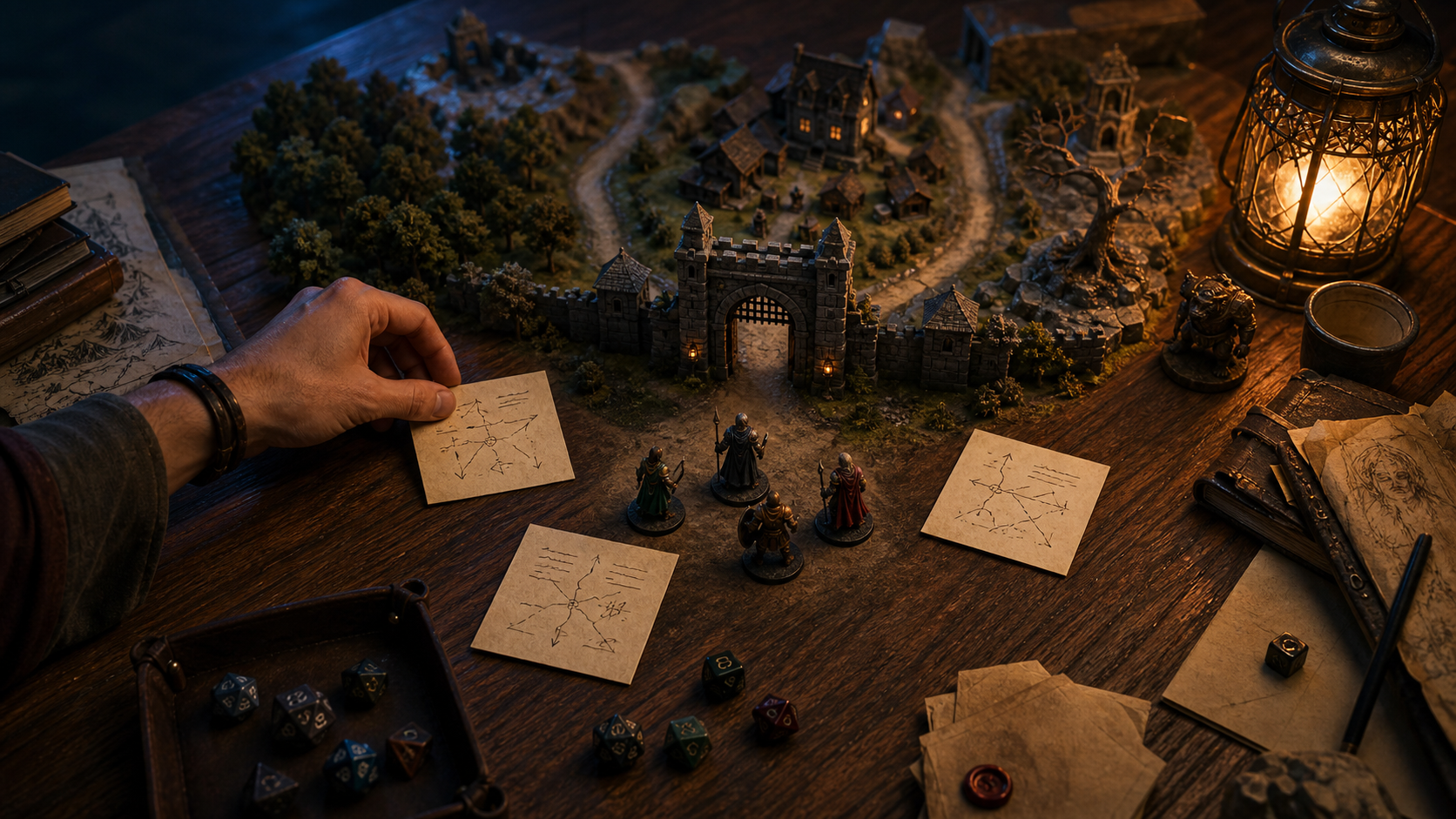
A prepared scene is not a scene your players are required to see. It is a live situation with enough pressure, people, and possibility that it becomes interesting no matter how they enter it.
The most common preparation trap is writing the next sequence of events: the party meets the informant, accepts the job, discovers the clue, and escapes the ambush. That may read well in your notes. At the table, it becomes fragile the moment the players decline the job, mistrust the informant, or set the building on fire.
A useful dramatic-scene framework identifies conflict, character development, plot function, and staging as elements that give a scene force. Those ideas are useful for DMs—but the job is different. A screenwriter controls the result. A DM prepares the forces at work, then lets player choices determine the result.
This guide translates those four elements into a DM-ready scene brief:Pressure, Wants, Change, and Playable Space. Use it to make a social scene, investigation, chase, or fight feel purposeful without deciding how the party will solve it.
Why scenes stall or feel forced
A scene stalls when no one needs anything now. It feels forced when the only interesting response is the response in the DM's notes. Both problems disappear when you prep a situation instead of a plot.
Situation-based prep gives you a world that can respond. You know what the people present want, what is at risk, and what will change if the party acts—or does not. The party still gets to choose whether to bargain, sneak, fight, investigate, leave, or invent an option you did not anticipate.
Prep the problem and its moving parts. Do not prep the players' answer.
Four things to prep for a dramatic D&D scene
When a change should carry emotional weight, the Anchor, Echo, Change, and Space method builds from shared history without scripting the response.
1. Pressure
2. Wants
3. Change
4. Playable space
You do not need all four to be complicated. A two-minute conversation can have a small pressure and one sharp change. A major confrontation may have several competing wants and a location that changes how every choice works.
Scene ingredient 1
1. Start with a pressure that has stakes
Conflict is not automatically combat. It is a goal meeting resistance. Give the scene something that is already in motion: a public accusation, a closing gate, a witness about to leave, a treaty deadline, a fire, or a secret that may be exposed.
Then state the stakes in one sentence: if this is not changed, what becomes worse, harder, or permanently different? Stakes make a choice matter. They do not tell players which choice to make.
Weak: “The party talks to the magistrate about the missing relic.”
Strong: “The magistrate is about to close the city gates because the relic disappeared during the party's watch; once closed, the only witness is trapped outside.”
The second version has urgency, but it has no mandated solution. The party might clear their name, bribe a guard, pursue the witness, steal a gate key, or accept the consequences.
Scene ingredient 2
2. Give the people present wants that collide
When each interaction is driven by what the people involved want, the scene gains momentum. At the table, you do not need to script lines; you need to know what an NPC is trying to get, what they fear, and what they will do next.
- Want: What are they trying to gain, protect, prove, or avoid?
- Leverage: What can they offer, withhold, threaten, or reveal?
- Limit: What will they not do, or what makes their preferred method costly?
- Move: What do they do if the party does nothing?
Give at least two forces an incompatible want. The party will create the third force by deciding whom to help, oppose, deceive, or ignore. That is how a scene gains momentum without needing a villain monologue.
If a want still feels too broad to guide play, use the five-part NPC motivation card to add stakes, a method, a limit, and a change from previous play.
Scene ingredient 3
3. Put a change on the table
A strong scene does not have to end in a twist, but it should be able to change something that later play can remember. The change might be a new alliance, a broken promise, a revealed fact, lost access, spent resource, altered location, or advancing clock.
Think in terms of state, not story beats. “The party learns the duke is corrupt” may be a reveal. “The duke now knows the party has the ledger” is a state change. The second tells you how the world can respond next session.
Useful test: When the scene ends, write one sentence beginning “Now, because of this…” If you cannot finish it, the scene may be color rather than a meaningful decision point—and color is fine, as long as you chose it deliberately.
Scene ingredient 4
4. Prepare a playable space, not a camera shot
Blocking and staging show a film audience who has power, what they can see, and where attention belongs. At a game table, translate that into the things players can interact with.
- Position: Who controls the doorway, high ground, crowd, paperwork, or exit?
- Information: What can be noticed, overheard, inspected, or learned from more than one source?
- Tools: What objects, people, customs, hazards, or terrain can change an approach?
- Motion: What will move while the party debates?
A tavern can be playable if the bartender has a debt, a courier keeps looking at the door, a rival recognizes the party, and a back room offers privacy at a cost. A throne room can be unplayable if it is only a backdrop for the king to deliver your next quest.
The one-card scene brief
Put this on one index card or one note. If it will not fit, you may be trying to solve the scene before the players arrive.
SCENE: [short situation name]

Pressure: [What is happening now, and what gets worse if no one acts?]
Stakes: [What can be gained, lost, exposed, or changed?]

Wants in collision:
- [NPC/faction]: wants [thing]; will [method] to get it.
- [NPC/faction]: wants [thing]; will [method] to get it.

Change on the table:
[A relationship, access, resource, belief, clock, or location state that could change.]

Playable space:
- [What can be noticed, used, questioned, or approached?]
- [What information has more than one route to reach the players?]
- [What can move if the players choose a different approach?]

Do not decide:
[The players' solution, alliance, route, or final outcome.]
Worked example: the closed gate
The party returns to Greywatch after a relic disappears during their patrol. A plotted version says, “The captain arrests them; they escape through the sewers; they find the thief.” Here is the same material as a playable situation.
Pressure and stakes
Captain Vey is closing the gates at sunset. If she does, the caravan carrying the only eyewitness leaves under guard and the party's names become public suspects.
Wants in collision
Vey wants order and a visible culprit. The caravan master wants to leave before nightfall. The thief wants the gate closed because their buyer is inside the city. Each has leverage; none needs to cooperate.
Change and playable space
The gate's status, Vey's trust, and the thief's anonymity can change. Players can question guards, inspect the wagon seal, use their reputation, create a distraction, follow the buyer's agent, or leave the city themselves. A groom, a guard roster, and a damaged crate each point toward the truth.
Notice what is missing: the thief's capture, a required sewer route, and the final explanation. You have enough material to play honestly when the party surprises you, because the situation has a logic that does not depend on one scene order.
Common mistakes
Writing an outcome in the pressure line
“The captain arrests the party” is an outcome. “The captain believes the party is responsible and has legal authority to detain them” is a pressure. The latter still lets the players change the situation.
Using a single clue with a single gatekeeper
If one NPC must give one clue, a failed roll or an argument can stop play. Put important information in the environment, on another person, in a consequence, or in a rival's actions too.
Confusing surprise with reversal
A reversal changes the situation because of actions and established motives. A surprise merely reveals what the DM was hiding. Favor the first: it gives players something they could have understood, influenced, or responded to.
Making every scene a climax
Not every tavern conversation needs a betrayal. Quiet scenes can deepen relationships, establish a cost, or give players room to choose their next goal. Reserve major irreversible changes for moments that earn them.
Keeping scenes connected in DMForge
The scene brief works in any notebook. In a long-running campaign, the harder part is remembering which people, places, promises, and prior consequences should shape the next situation. DMForge can help you keep the original session record, review the Encounters and connections it finds, and later navigate the accepted history by person, place, event, or relationship.
That makes it easier to prepare from what your campaign has actually established—while you remain the person who decides what is true and what any NPC will do next.
Start a free DMForge campaign when you are ready to keep those moving parts connected.
Further reading: For a complementary RPG prep principle, read “Don't Prep Plots”.